The Clock Behind the Carvery: How a Proper Sunday Roast Comes Together
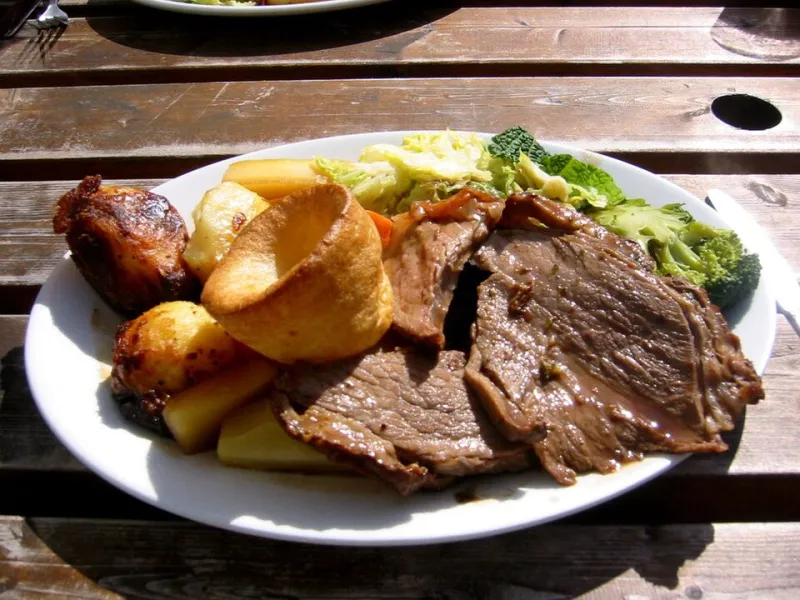
Photo: Jeremy Keith (Flickr user "adactio"), CC BY 2.0, via Wikimedia Commons
At The Woolpack, Sunday lunch is not a spur-of-the-moment dish. It is a timetable with gravy on the end of it. By the time the first plate leaves the pass, the kitchen has already been working for hours: spuds peeled and parboiled, joints seasoned and brought up to room temperature, stock reduced, Yorkshires batted out, greens trimmed. The roast is less a recipe than a well-run ritual — and the clock is as important as the carving knife.
The roast is a timetable, not a recipe
Ask a home cook what makes a good Sunday roast and they will talk about meat, potatoes, gravy. Ask a pub kitchen and they will talk about oven space, resting time and the fact that twelve tables have all decided to arrive at 1.15pm. A proper roast is a logistical exercise dressed up as lunch. The trick is not doing everything at once. The trick is deciding what can be done yesterday, what can be done this morning, and what must wait until the last possible minute.
That is the first thing home cooks can borrow: stop trying to cook the whole meal in one heroic hour. A pub does not. A pub spreads the work out so that Sunday lunch still feels like Sunday lunch, even for the people cooking it.
Saturday: the quiet shift
The Sunday roast starts on Saturday. Not the cooking, necessarily, but the clearing of the decks. In a pub kitchen, that means checking the meat order, making sure there are enough potatoes for the number of covers, and getting stock on if it is not already in the freezer. It means peeling a sack of spuds — or at least getting them into water — so that Sunday morning is not a race against the first booking.
At home, this is the difference between a relaxed morning and a kitchen that looks like a flour bomb has gone off. Peel and cut your potatoes the day before, keep them in cold water in the fridge, and change the water once. Make the gravy base ahead: roast some bones or wings, simmer them with onion, carrot and a bay leaf, strain it, and reduce it. Come Sunday, you are not making gravy from scratch. You are finishing it.
You can also make the Yorkshire pudding batter the night before. It will be better for the rest. Same with stuffing if you are doing one. Same with peeling carrots and swede. None of this is cheating. It is just good kitchen sense.
Sunday morning: peel, parboil, prep
Sunday morning in a pub kitchen is steady rather than frantic. The first job is the potatoes. They are peeled, cut to a decent size, and parboiled until the outside is soft but the middle still has bite. Then they are drained, shaken in the pan to rough up the edges, and left to steam dry. That rough surface is what makes them crisp later. If you put wet potatoes into hot fat, they will not thank you.
The meat comes out of the fridge early. A joint straight from the cold will cook unevenly, so it gets time to come up towards room temperature while the ovens heat. It gets seasoned properly — salt, pepper, maybe a few herbs — and then it waits its turn. The ovens are already busy with the things that can hold: braised red cabbage, cauliflower cheese, a tray of roots.
This is the part home cooks often miss. You do not need to roast everything at the last minute. Some things are better for a long, slow spell in the oven. Some things can be reheated without shame. The roast potatoes and the meat need the final push, but the supporting cast can be ready and waiting.
The ovens: a queue, not a crowd
A pub kitchen does not cram everything into one oven at one temperature. It uses a queue. The meat goes in first if it is a large joint, because it needs the longest rest. The potatoes go in when the meat comes out, because they need high heat and space. The Yorkshires go in last, because they are quick and they do not like being kept waiting. The greens are blanched ahead and finished in a pan at the pass.
That is the second lesson for home cooks: work out what needs the oven, what needs the hob, and what needs nothing at all. A pub might have more space than your kitchen, but the principle is the same. If everything needs the oven at 200C for forty minutes, you have designed a problem for yourself. If the carrots can be glazed on the hob and the cabbage can be braised ahead, you have given yourself room to breathe.
Resting is not waiting
The meat comes out before the plates go out. This is not a pause. It is part of the cooking. A joint needs to rest so the juices settle, and that rest gives the kitchen time to get the potatoes crisp, the gravy hot and the plates warmed. In a pub, the resting time is built into the clock. It is not an afterthought.
At home, this is where people panic. They take the chicken out and immediately start carving, then wonder why the juices run all over the board. Give it ten minutes, fifteen for a larger joint, loosely covered. Use that time to finish the gravy, warm the plates, and get everyone to sit down. The roast will be better for it, and so will you.
Gravy: the last jug matters
Gravy is the last thing to be finished and the first thing to be judged. In a pub kitchen, the roasting tin is deglazed with stock or wine, scraped down, strained if it needs it, and thickened just enough. It is kept hot, but not boiling, and it is sent out in jugs so people can help themselves. The last jug matters as much as the first. There is nothing worse than a dry plate at the end of the table because the gravy ran out.
For home cooks, the make-ahead gravy base is the secret weapon. Finish it with the meat juices, a splash of whatever you cooked the meat with, and a little butter at the end. Taste it. If it is flat, add salt. If it is heavy, add a squeeze of lemon or a dash of vinegar. Gravy is not a packet. It is a small, savoury project, and it deserves a few minutes of attention.
What home cooks can borrow
If you take one thing from a pub kitchen, take the timetable. Write down what can be done on Saturday, what can be done before the meat goes in, and what must be done in the last half hour. Peel the potatoes early. Make the gravy base early. Parboil the spuds early. Decide which vegetables can be cooked ahead. Then give yourself permission to sit down for ten minutes with a cup of tea while the meat rests.
A Sunday roast does not need to be a performance. It needs to be a well-run ritual. The clock is not the enemy of a good lunch. It is what makes a good lunch possible — first peel to last gravy.