Thirteen Steps and a Creaking Floorboard: The Case for Sleeping at the Inn
There is a noise a village inn makes at around eleven at night that no hotel has ever managed to reproduce. The bolt goes across the front door. The last glass is collected. Somebody in the cellar turns off the line and the hand pumps go quiet, all at once, like a room settling into a chair. Then the stairs. Thirteen of them here, with the fourth one creaking in a way we have made peace with, and a guest going up them slowly with a glass of water and no particular reason to hurry.
That is the whole business, really. Not the thread count. The thirteen steps.
A Hotel Checks You In. An Inn Takes You In
We ought to be plain about the difference, because the two things get muddled constantly and the muddle does nobody any favours. A hotel is a machine for selling nights. It is very good at it, and there is nothing wrong with that — but it is a machine, and it knows it. Corridors with no daylight. A lift that dings. A key card that forgets you the moment you stop being useful.
An inn is a house that happens to have a licence and a spare room. That is a considerably more demanding proposition. When somebody sleeps under your roof, you have agreed to be responsible for their night: their quiet, their warmth, their water pressure, the five o'clock worry about whether the sash window will rattle in the wind. You have also, whether you like it or not, agreed to be the last thing they see before they sleep and the first thing they hear when they wake. In a hotel, that is a service. In an inn, it is a relationship, and a slightly one-sided one at that. They know what you look like with your apron off. You know which side of the bed they sleep on. It's intimate, in the old-fashioned sense, and it can't be faked with a bowl of lavender by the basin.
The Weight of the Bedroom Door
If you want to judge an inn, don't look at the bar. Look at the door of room three.
It should be heavy, or at least feel as though it means it. It should close with a proper thunk and not a hollow clap. It should have a key — a real one, brass, on a fob with enough heft that you notice it in your pocket on the way to the car — and turning it should feel like being let in rather than logged in.
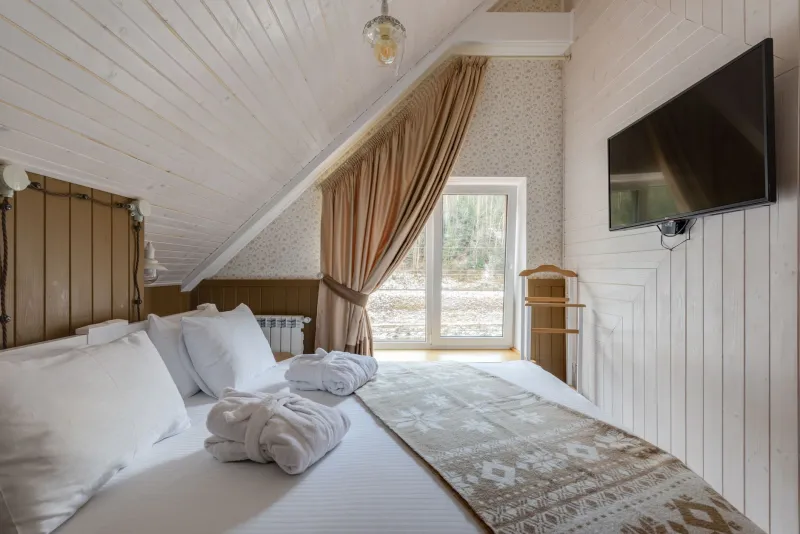
Beyond that door, the list is long and unglamorous and we make no apology for it. A kettle that boils in under four minutes. A jug of actual milk in the little fridge, not a plastic pod of something that has never met a cow. Two decent pillows, not four decorative ones. A lamp by the bed bright enough to read a paperback by without moving your head into the light like a man inspecting a fuse. A chair you can sit in wearing a coat. A window that opens. A radiator you can turn down at two in the morning without having to solve it first.
None of this is boutique. We are not going to stencil a quote about dreaming onto the wall. But an inn room that gets these things right is worth ten rooms with a rainfall shower and no chair, and every guest who has ever stayed in both knows it.
Last Orders, Then the Hush
There is a moment, after the pub empties, that is the entire reason to stay rather than drive home. The hush. It isn't silence — the extractor fan is still going, somebody is stacking chairs, the dog is doing its rounds of the carpet in case a crisp has been missed — but it is a particular kind of quiet that only exists at the end of a good evening in a building that has decided to keep you.
The guest who comes down for a last half, or who lingers on the landing because the chatter below is companionable, is not an inconvenience. They are the point. A village inn without a bed upstairs is a lovely thing. A village inn with one is a different creature altogether: a place where the evening doesn't have to end in a taxi argument.
What we owe, then, is not entertainment. It's the courtesy of not being hurried. No music in the corridor at half past six in the morning. No clatter of a function being set up under your feet. If the church bells go at eight, that's the village and we're not apologising for it — but they should be the loudest thing you hear.
Breakfast Is the Reckoning
Everything an inn claims about itself is settled at about half past eight the next morning.
Hospitality is easy at nine at night with a fire going. It is considerably harder at eight in the morning with a hangover, a delivery, and a boiler that has decided to be temperamental. And yet breakfast is where the guest decides, quietly and permanently, whether they will come back.
So: a proper pot of tea, not a cup of hot water with a bag beside it. Bacon that has been grilled rather than waved at a pan. Eggs with yolks the colour of something that had a decent life. Bread worth toasting, from a baker who is not a lorry. A vegetarian option that isn't an apology. Jam in a jar with a spoon in it. And somebody to say good morning who actually means it, because a guest can hear the difference from the doorway.
You cannot send a person home happy on a sad croissant. You can send them home happy on a sausage, a pot of tea, and the news that it's raining again.
What We Owe, Stated Plainly
An inn is not a hotel with hand pumps bolted on, and it does itself no favours pretending otherwise. It doesn't owe you a spa, a concierge, or a chocolate on the pillow. It owes you a warm room, a quiet night, a working shower, an honest breakfast, and the feeling that the building is pleased you're in it.
In return, we'd ask one thing. Go to bed when you're ready, but don't rush off at dawn. Come down. Have the tea. Tell us what the bed was like. An inn learns its trade one guest at a time, and the fourth stair will still be creaking next winter, and we'd rather you told us than didn't.