The Story Above the Door: Why a Woolpack Still Means Welcome
There are pub signs that tell you where you are, and pub signs that tell you what the country used to do. The Woolpack is firmly in the second camp. It is a name that smells faintly of lanolin, woodsmoke and wet fleece — and it has been earning its place above English doors for centuries.
A Bundle, a Road, and a Reason to Stop
A woolpack was not a glamorous object. It was a bale of fleece, pressed and tied, heavy enough to need a pony and awkward enough to need a patient handler. In the medieval and early modern wool trade, those packs moved along tracks and drove roads from sheep country to market towns, cloth-making districts and ports. The people moving them needed three things: a bed, a stable and a hot meal. The inns that provided them often took the pack as their sign — a straightforward piece of branding that said, in effect, goods welcome, travellers fed.
That is the useful thing about the name. It does not promise heraldry or a fancy family. It promises function. A woolpack inn was part of the working landscape: a place where a drover could settle a bill, a merchant could check a consignment, and a local farmer could hear the market news before heading home. In a country whose wealth was once woven from fleece, the sign was a small public statement that this house understood the trade.
From Market Day to the Village Pump
The wool trade rose, shifted and eventually declined, but the name did not. It hung on in sheep-rearing country and market towns, and it survives today on pubs that may have little direct connection to a packhorse route. That is not fakery. It is how names work in Britain: they become part of the furniture, a layer of local memory that outlasts the industry that made it. A Woolpack sign is a reminder that the English inn grew up around movement — livestock, wool, beer, people — and that hospitality was never just a nice idea. It was infrastructure.
Look at the places that still carry the name and you will usually find the same ingredients nearby: old market squares, church towers paid for by wool money, lanes that once carried flocks, and a landscape of fields and folds. The sign is not a museum label. It is a bit of working history that happens to sell lunch.
What We Owe the Old Sign
At The Woolpack Inn, we do not pretend to be a living exhibit. We are a pub and inn, not a heritage centre. But we do think the name carries an obligation. It asks for local ale rather than a line of identical taps, for plates that make sense after a long walk, and for a welcome that does not depend on how much you spend. A proper pie with gravy, a pint pulled through the hand pump, a chair by the fire when the rain is coming sideways — these are not nostalgic decorations. They are the modern version of what an inn was always for.
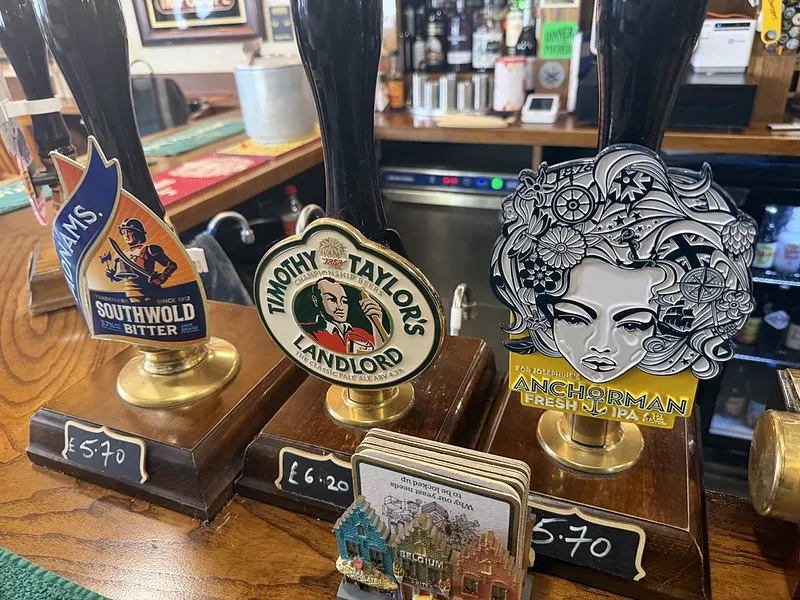
That is why our bar leans towards cask ale from breweries with a sense of place, and why our kitchen treats hearty food with respect rather than irony. You can come in for a quick half and a bag of crisps, or you can settle in for a slow-cooked dinner. Both are in the spirit of the woolpack. The pack was heavy, but it carried value. A good inn carries the same idea: something worth stopping for.
The Name Is a Promise
So next time you see a Woolpack sign, look up at it for a second. It is not just a quaint bit of old England. It is a record of roads, markets, animals and weather; of people who needed somewhere to rest and someone to put the kettle on. In 2026, that still feels like a decent reason to open the door.
We are proud of the story above our door. More importantly, we are proud to keep it useful: a warm room, a full plate, a local pint and a welcome that means it. The wool trade may be long gone, but the hospitality it helped build is still on the menu.